
Our Stories
Tina and her family story
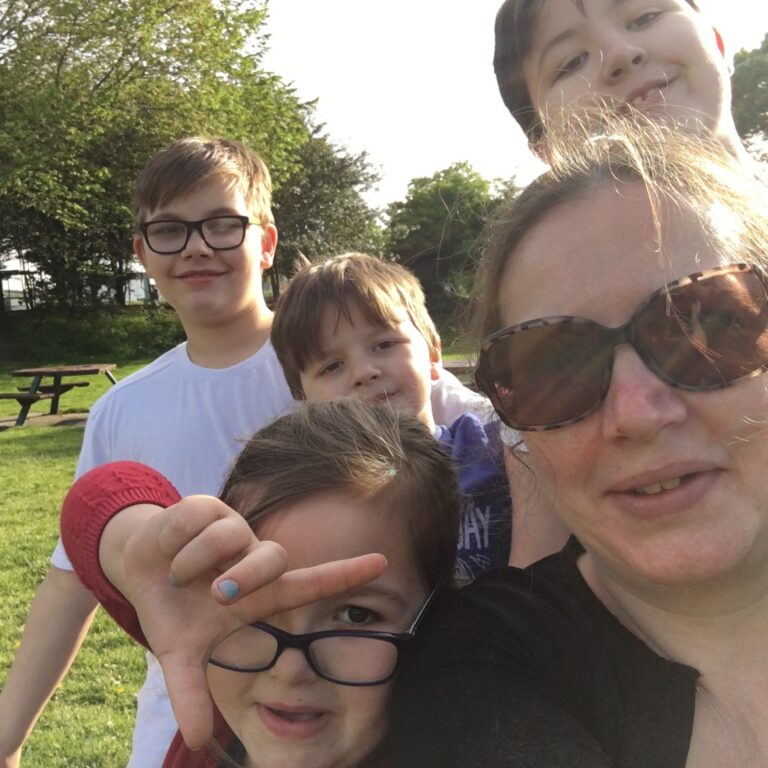
My name is Christina (Tina). I’m 47 and I have five children, aged 28, 19, 17, 13 and 12. I was born in East Sussex, grew up and went to school there, and moved to Scotland in 2000.
Whilst growing up I experienced my parents’ separation and divorce, as well as other childhood trauma. All throughout my childhood and early adulthood I found things really difficult, such as learning and school. I found it hard to retain information and it took me longer to process things. I would only read out loud to an individual adult, I used to hide away if I could, friendships were hard and I was bullied a lot. I gave up on school.
I always felt different, and found understanding others and the world around me challenging. Even now I find it difficult to fit in (a lot of masking).
At 16 I was offered a job in a care home by a friend’s mum. Again I struggled with colleagues and experienced some bullying, and this is where I met my eldest daughter’s dad.
I had my eldest daughter at 19, and aged 21 I moved to Scotland and went to college and university. But again, retaining information and processing things were really difficult, and fitting in with other students and making friends was really challenging. I ended up having a breakdown, my mental health deteriorated, and I was diagnosed with borderline personality disorder.
I then went on to have four more children between 2007 and 2014, and with three of the younger children I noticed a lot going on for them, such as behaviours, sleeping difficulties, learning and development, speech, delayed motor skills, sleep apnoea, dislocation, immobility, minor feeding difficulties and sickness episodes (cyclical vomiting).
Unfortunately, due to my own communication needs and other trauma going on in my life, trying to express my concerns about all of this to professionals became challenging. I felt not listened to, and at times thought I was going mad.
In 2017 I moved back down to Sussex, and whilst in temporary accommodation, with temporary doctors and schools, I was finally listened to and referrals were made for the children to be assessed.
At one of the first hospital appointments I was asked to consent to genetic blood testing. More was being recognised in the schools, and more referrals were made to speech and language therapy, opticians, occupational therapy, the Evelina and nephrology.
Fast forward to August 2020, during lockdown, and a letter was sent with the findings. Their dad was found to have a chromosome 7 deletion, and three of the younger children and I were identified as having a change in the POGZ gene, and were therefore diagnosed with White Sutton Syndrome. We were sent links to the website and told that it is a very rare condition, that not many people are diagnosed, especially in the UK, and that there is very little awareness in the UK.
This diagnosis was a massive shock, but looking back, everything I’d noticed with the children and my own difficulties began to make sense. But then, who to speak to, and what to do with the new diagnosis?
Fast forward to 2026 and we now feel totally accepted and knowledgeable about the diagnosis. I have also received genetic counselling in 2026 from Guy’s and St Thomas’ in London, which has helped me to talk through my issues with a professional.
In the years since the diagnosis, through the White Sutton Syndrome website and social media such as Facebook and WhatsApp, I have connected with many families around the world who have also been diagnosed with White Sutton Syndrome, and have also found several new families who have been diagnosed in the UK. This has been an enormous help.
Still to this day, in the UK, there is a huge lack of awareness of White Sutton Syndrome throughout the NHS and other professional bodies. One of our parents’ social media groups is trying to change this by slowly raising awareness. This will also help to shape the knowledge of future families when they join these groups.
This website will help families to share each other’s stories, find common ground and hear about upcoming conferences, where we hope to be able to meet up together regularly.