
Our Stories
The Macdonald family story
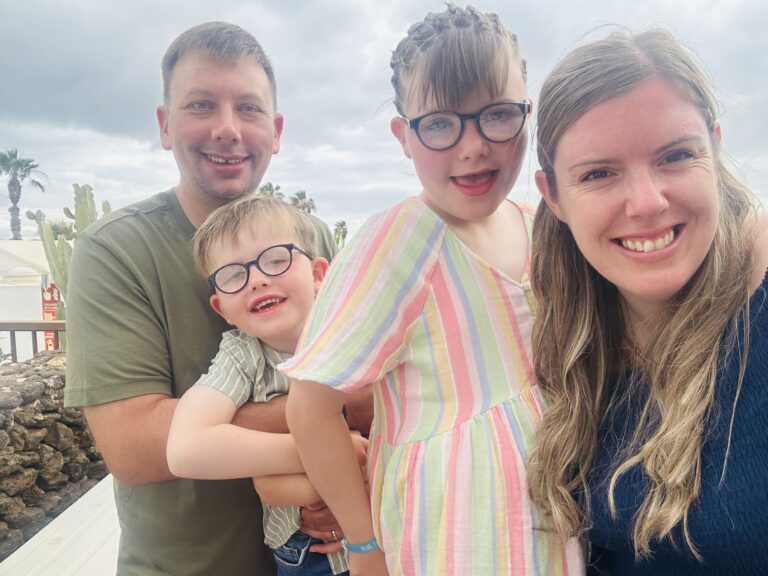
Back in 2017, newly married and starting a family, we welcomed our little girl Jessica into the world, the most perfect little girl. Soon after her arrival we started to notice some differences in her development. Feeding was a difficulty: Jessica was unable to breastfeed due to her latch, and was later diagnosed with a cow’s milk protein allergy.
Over the coming years we noticed Jessica’s development was delayed, including her communication, emotional and fine motor skills. We were added to numerous waiting lists throughout the years, waiting to be assessed for what they thought was possible autism. Jessica attended an under-3s placement at our local nursery, then started mainstream education, where she had intensive therapies.
Through a routine check-up it was advised that we see a genetics specialist at our local hospital for a full genetic investigation. Before this could be carried out, Jessica underwent a cognitive assessment and was diagnosed with a learning disability.
A short while later it was decided that Jessica and my husband Allan, who presented with the same features (wide-set eyes, a small fat lip and the same cognitive impairment), would both go through genetic screening. After around four months we got the phone call to attend the genetics clinic. At this meeting we found out that both Jessica and my husband have WSS, and we were sent on our way with a leaflet and very little support or information.
On finding out about WSS, we tested our younger boy Oliver and found out that he is also a carrier of WSS. The struggles throughout the years finally all made sense: speech delay, hypertonia, CVS and delays in development were all coming together under this one umbrella, along with new autism diagnoses. My husband, aged 40, finally had an answer to his struggles at school and into adulthood, where he had always been diagnosed with dyspraxia and a learning disability.
We found very little information on WSS and really had to do our own research, with lots of unanswered questions:
What does this mean for the future?
What support needs to be in place to support the children and my husband?
Is everything going to be OK?
Looking for that support, I came across some UK families in the same position, who had unanswered questions and wanted to meet other families like them. We were then added to a small WhatsApp group, and the rest is history.
Since our diagnosis we are still navigating WSS as a family, making sure that the correct support is in place for the children, be that at school, speech and language therapy, or individual support plan meetings, to ensure they are reaching their full potential.
The children are thriving. Jessica has learned to tie her shoelaces, has just been discharged from speech and language therapy, and is a very fun-loving, sociable nine-year-old. Oliver is enjoying starting school and, with the correct support, is really engaging in a mainstream setting. He has learned to ride his bike, dress himself, and make himself a drink and a sandwich. Allan has had support from an employability support worker and is thriving in a full-time job.